
KATE JENNINGS LEADERSHIP DEVELOPMENT
What is Influencing Others in Leadership?
Influencing others is the ability to shape thinking, decisions, and outcomes without relying on authority alone.
Used well, it helps leaders build alignment, gain buy-in, and move work forward more effectively.
What does influencing others mean?
Influencing others is about how you communicate ideas, build credibility, and engage people in decisions.
It is not about persuading people to agree with you. It is about helping others understand different perspectives, consider options, and commit to a way forward.
Effective influence is grounded in clarity, credibility, and an understanding of what matters to others.
Understanding different communication styles
Amiable
Cooperative, supportive, relationship-focused.
Values trust and harmony
Expressive
Energetic, enthusiastic, idea-focused.
Values engagement and inspiration
Analytical
Precise, structured, evidence-focused.
Values logic and detail
Driver
Direct, action-focused, results-oriented.
Values efficiency and outcomes
These styles underpin the Z tool (below) and help explain why different approaches to communication are needed when influencing others.
Why influencing matters
When influence is limited:
Good ideas are not taken forward
Decisions are delayed or diluted
Alignment is harder to achieve
Frustration increases
When influence is effective:
Ideas are understood and supported
Decisions move forward more quickly
Stakeholders are engaged
Teams work with greater clarity and direction
What supports effective influence
Influence is shaped by how well you understand both the situation and the people involved.
More effective approaches include:
Being clear on your own position and purpose
Understanding what matters to others
Framing ideas in a way that connects with different perspectives
Using questions to explore rather than push
Adapting your approach depending on the context
Influence is rarely about one conversation. It develops over time through consistency and credibility.
The Z Tool
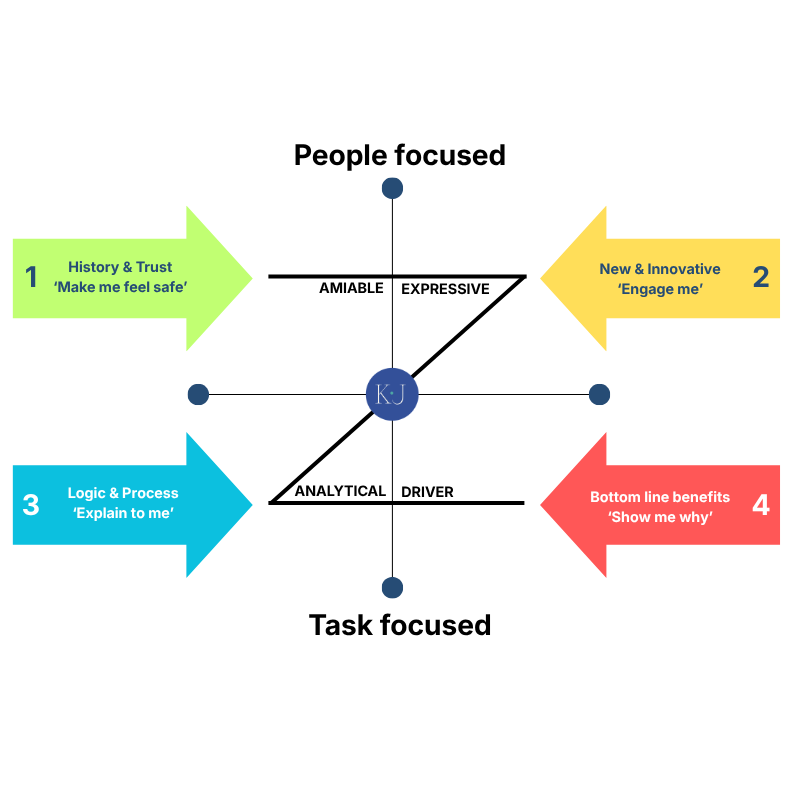
The Z tool is a simple way to think about how you adapt your communication when influencing others.
It recognises that people tend to engage with information differently, and that influence is more effective when you adjust your approach accordingly.
The tool highlights four broad communication preferences:
Amiable – focused on relationships, trust, and collaboration
Expressive – focused on ideas, vision, and possibilities
Analytical – focused on data, detail, and evidence
Driver – focused on results, outcomes, and action
Most people will have a preference, and situations often require a balance across these styles.
In Practice
Leaders influence more effectively when they:
Prepare their thinking before key conversations
Consider what matters to different stakeholders
Use questions to understand and engage
Communicate clearly and concisely
Stay open to challenge and adjust their approach
Common Challenges
Common challenges include:
Balancing confidence with openness
Managing disagreement without losing momentum
Influencing without formal authority
Adapting style across different stakeholders
Maintaining clarity under pressure

Applying Influencing Others
If this is something you’re working on, there are two ways to build on it.
Use this in your own work
Download this guide to support more effective influencing in your day-to-day conversations.
Build this in your organisation
Effective influence is a core leadership capability, particularly in complex or technical environments.
You may also find these useful: Psychological Safety and Managing Conflict
Frequently Asked Questions
-
It refers to the ability to shape thinking, decisions, and outcomes through communication, credibility, and understanding, rather than authority alone.
-
Leaders rely on influence to build alignment, gain support for ideas, and move work forward, especially where they do not have direct control.
-
By understanding stakeholders, communicating clearly, asking effective questions, and adapting their approach to different situations.
-
No. Influencing is broader. It includes listening, understanding, and shaping thinking, not just persuading others to agree.
Explore all leadership development tools
View all 10 leadership tools and find the right approach for your current challenge.